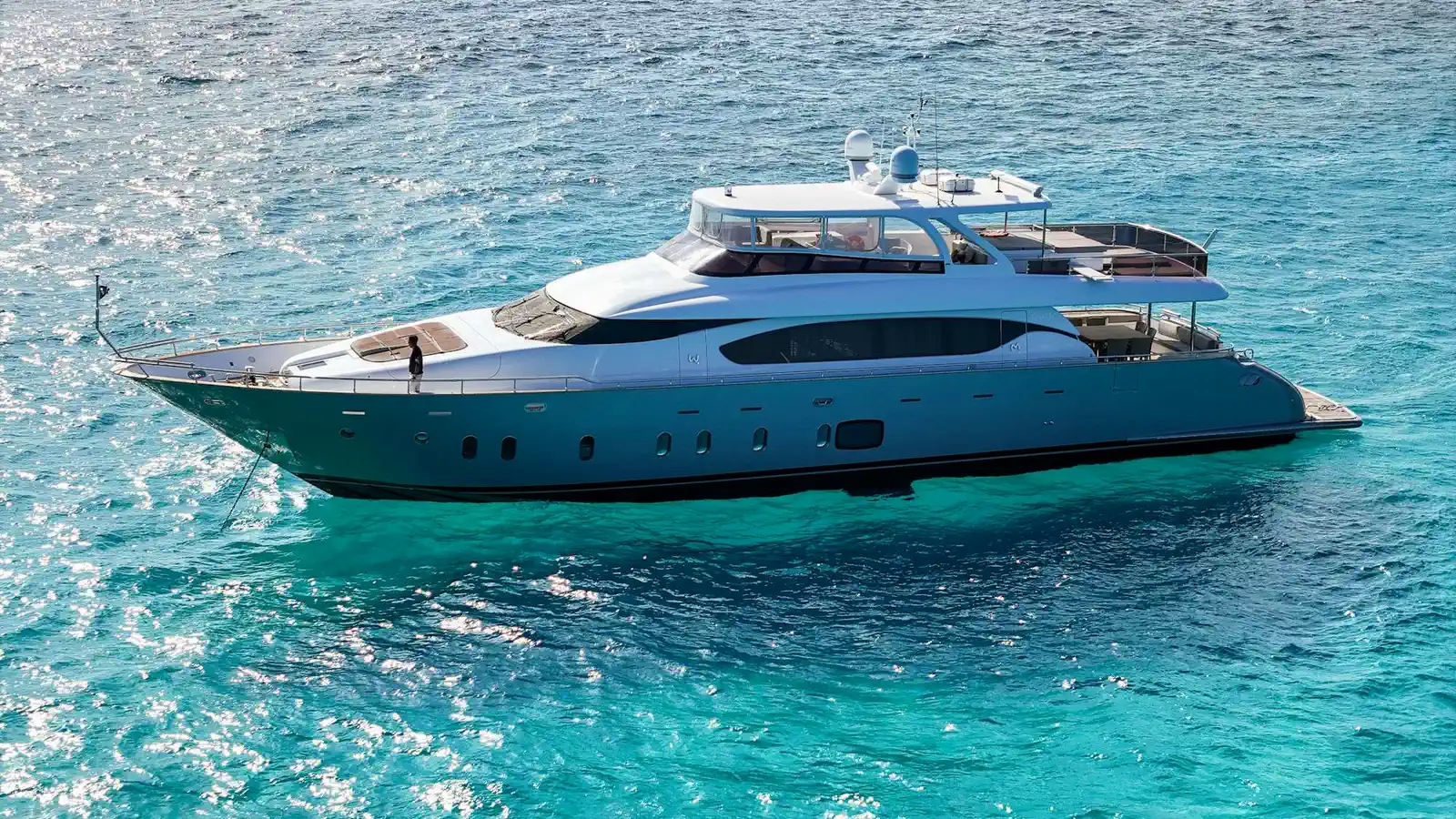
Crewed Yacht Charters Across South Florida, the Keys & The Bahamas.
A few hours on the water and a week aboard are different purchases. Compare the vessel, the life aboard and the expense structure with the same care as the destination.
South Florida & Bahamas day yachts: typically ~$6,500–$12,000 per day.
A week away
Weekly crewed catamarans & motor yachts: ~$30,000–$150,000+/week + 25%–35% APA, 10% Bahamas VAT and applicable Bahamas Port Department charter fees (confirmed per vessel in the written charter agreement).
Reviewed October 2026. ALINARI-selected planning bands reviewed alongside MYBA — charter agreement framework and IYC — luxury yacht charters for market and charter-term context. These are not published MYBA tariffs; the exact day band is ALINARI guidance. Bahamas yacht charters are subject to 10% Bahamas VAT and applicable Bahamas Port Department charter fees (confirmed per vessel in the written charter agreement). For multi-night plus-expenses charters, plan for 25%–35% APA (Advance Provisioning Allowance), subject to vessel terms; some require more. Applicable Florida sales/charter tax applies to Florida coastal charters. Explore the Planning & Pricing Guide.
EMBARKATION & CRUISING AREAS
South Florida, Bahamas & Caribbean cruising corridors.
South Florida & the Keys
Discuss Miami & Biscayne Bay, Fort Lauderdale, Palm Beach, or Naples & Southwest Florida for embarkation and local cruising. Florida Keys preferences can include Key Largo, Islamorada and Key West; the vessel, base, available time and captain-approved route determine which stops fit.
The Bahamas
Plan around Nassau & Paradise Island, The Exumas (Norman's Cay, Warderick Wells, Staniel Cay), The Abacos (Marsh Harbour, Hope Town, Green Turtle Cay), or Harbour Island & North Eleuthera. Confirm the actual embarkation marina, draft, access requirements and cruising scope in the proposal.
Caribbean winter itineraries
St. Barths, the British Virgin Islands and Antigua are preferences for a tailored quote. Vessel availability, positioning, local requirements and realistic passage times need review before an itinerary is confirmed.
TWO DIFFERENT BRIEFS
A day on the water—or a life aboard.
Four or eight hours
For a day request, prioritize the boarding point, local start time, shade, seating, swim access and a realistic cruising area. Ask how much of the period is spent underway versus at anchor, and whether boarding or return arrangements affect your usable time. The planner’s four- and eight-hour choices are requests—not a promise that every yacht offers those durations.
An overnight or longer charter
For a term request, compare the sleeping plan as carefully as the social spaces: doubles versus twins, en-suite facilities, cabin access and privacy between groups. State the desired nights and embarkation/disembarkation dates. The planner accepts 2–60 nights, but each vessel’s actual minimum, availability and charter terms require confirmation.
The people and operating arrangement
Distinguish guests visiting for the day from guests sleeping aboard. Ask the provider to confirm the permitted numbers for the actual charter and the crew arrangement. Cabin berths, marketing occupancy and vessel size are not interchangeable proof of permitted passenger capacity. A larger yacht should not be selected simply to assume more guests are allowed.
Use these guides to compare the vessel, crew service, itinerary and price structure in your proposal.
CHOOSE A PACE
Give the time aboard a purpose.
Four hours: one clear highlight
Choose the moment that matters most: a local cruise, a suitable swim stop or time together at anchor. Ask for a plan that shows boarding, the safety briefing, passage time and the return. Do not squeeze a distant destination, a long meal and several activities into the same short window.
Eight hours: more room, not unlimited distance
Use the longer day to improve the pace before extending the route. Ask what cruising area and fuel assumptions the price covers, and whether a longer or faster passage adds cost. Confirm the actual boarding and return times, treatment of late arrival and whether an extension is possible.
Two or three nights: keep the circuit compact
Focus on the first evening, a satisfying full day and a practical departure. Ask whether returning to the same base makes better use of the time than a one-way arrangement. A short request still needs the yacht’s minimum term and rate basis to be confirmed.
Four to seven nights: settle into a rhythm
Decide how much time you want underway, swimming, dining aboard and ashore. A few priorities are more useful than a minute-by-minute route. Cabin privacy, storage and overnight comfort become central when the vessel is your home for several days.
Eight to sixty nights: plan the life aboard
Discuss provisioning stops, laundry, connectivity, guest changes and marina nights. Ask the provider to identify service interruptions, crew arrangements and permitted cruising areas across the whole period. A longer request is not an assumption of availability or a simple multiplication of a weekly price.
FIND YOUR DIRECTION
Understand the differences.
The most useful distinction is often how you want to spend time aboard. Open each guide for layout questions, model-specific reference points and the trade-offs behind the category name.
Evaluate separate guest spaces, service priorities and tender arrangements without assuming that size establishes guest capacity or included amenities.
Separate the charter fee from the spending aboard.
Ask which contract and expense structure is being proposed. A base fee, an allowance for operating expenses and an advertised package are not automatically comparable totals.
The vessel, period and crew service+
What exactly is the charter fee buying: which yacht, which dates or hours, which guest numbers and what operating arrangement? For a crewed proposal, ask who is aboard and which services are part of that fee. Do not infer the number of crew, chef service, housekeeping or a particular service level from the yacht category alone.
Fuel, itinerary and repositioning+
Ask whether the quote assumes a cruising allowance, a particular route or fuel charged according to use. Establish how tender or water-toy fuel is treated. If the yacht must move to your preferred boarding port or be returned elsewhere, ask whether delivery or repositioning costs are additional.
Food, drinks and provisioning+
Tell the provider the type of dining and beverages you want, then ask what is included, capped or charged separately. For an overnight trip, agree how preferences are collected and how special items are approved. Do not read “crewed” as a promise of unlimited food, premium drinks or a particular menu.
APA or another expense allowance+
Where an Advance Provisioning Allowance is used, ask which operating expenses it funds, how the initial amount is set, who records the spending and when accounts are available. Confirm how extra funds would be requested and how an unused balance is returned. An APA is not automatically an additional service fee or a universally fixed percentage.
Ports, taxes, communications and extras+
Check dockage, port or clearance costs, applicable taxes, communication charges, premium activities, shoreside arrangements and any other extras. Ask whether a discretionary gratuity is separate. Taxes and expenses depend on the vessel, itinerary and charter agreement.
Payment, cancellation and itinerary changes+
Review the actual agreement, payment schedule, security arrangements and cancellation terms. Ask how weather, access restrictions, a vessel issue or a change in your plans would be handled. Understand the captain’s operational role and the difference between an intended itinerary and an assured sequence of stops.
THE PERSONAL DETAILS
Describe the experience you want to live.
Cabins, privacy and access
For overnight stays, specify cabin sharing, bed preferences and where privacy matters. Ask for the actual guest layout and photographs. Describe boarding or access requirements early: steps, companionways, deck transitions, tender boarding and water access differ between vessels.
Amenities that matter to you
Treat air conditioning, internet, stabilizers, shaded dining, tenders and water toys as items to verify—not boxes assumed from a luxury photograph. Ask whether the exact equipment is aboard, working, available during your dates and included, and whether local rules or your group’s experience affect its use.
Food, celebrations and family time
Share the atmosphere you want: quiet dining, time swimming, a celebration or a family-led pace. Ask about the practical arrangements for children, dietary preferences and any pet request. Do not put passports, payment details or sensitive health information into the initial charter brief.
The route and the arrival
Discuss realistic passage time, weather alternatives, anchoring or berth plans and the final disembarkation point with the provider. If flying in, separate the flight arrival from the yacht boarding window and include the actual airport-to-marina transfer. A shared brief helps reveal a timing gap; it does not guarantee the connection.
FROM BRIEF TO DEPARTURE
What should happen, and when.
STEP 1
Define the time aboard
Choose a day or term request, the area, party and boarding preferences. For a stay aboard, add sleeping arrangements and the rhythm you want for the trip.
STEP 2
Compare named vessels
Review the actual layout, permitted guests, equipment, crew arrangement and availability. Ask for vessel-specific details rather than treating stock photographs as an offer.
STEP 3
Reconcile the full cost
Separate the charter fee, operating expenses, allowance arrangements, taxes and optional requests. Confirm the currency, payment schedule and cancellation conditions.
STEP 4
Agree the charter and preferences
A real charter needs the relevant agreement and provider confirmation. Then refine provisioning, activities, boarding and transfers through the agreed communication channel.
STEP 5
Keep the itinerary workable
Obtain the final boarding instructions and operational contact. Expect the actual route and activities to be assessed for the yacht, area and conditions alongside your preferred itinerary.
A MORE INFORMED REQUEST
Questions before you choose.
Is a crewed yacht charter automatically all-inclusive?+
No. Ask which costs and services the particular quote includes. A vessel may be offered under an expense-separate structure, a stated package or other specific terms. The written proposal and agreement should explain food, beverages, fuel, ports, taxes and extras clearly enough to compare.
Can the same yacht carry the same number by day and overnight?+
Do not assume that. Ask for the permitted guest numbers for the actual charter arrangement, separately from the berth count and cabin layout. The operating provider must assess the vessel and service; this website does not certify capacity.
Why do crewed, skippered and bareboat labels matter?+
They can describe materially different arrangements. Ask who contracts for the yacht, who provides or selects the captain, which hospitality services are included, and who is responsible for the operation. A captain-only option is not automatically a chef-and-meals package. Have the actual legal and operating structure explained rather than treating the labels as interchangeable.
Are water toys and tender excursions guaranteed?+
No. Confirm the exact equipment, crew support, availability, price treatment and operating conditions. Ask whether experience, local restrictions, weather or other requirements affect who can use it and where. A photo of equipment does not establish its inclusion.
Can we use a day charter to cross from Florida to the Bahamas?+
The four- or eight-hour planner option is not a promise of an international crossing. Submit a realistic local day brief, or discuss an appropriate term itinerary with the provider. Flying to join a yacht already based in the islands is a separate arrangement to compare.
What happens when I submit a yacht charter brief?+
Your yacht charter brief is logged with an ALINARI reference number and delivered to the Private Charter Desk at charter@alinariairandsea.com for personal review within one business day. Submitting a brief does not reserve a vessel, lock a rate or collect payment; vessel availability, crewed or term structure, APA, Bahamas VAT or Florida tax treatment, and final pricing are confirmed in your written charter proposal.
Technical references Checked 2026-10-24
Specifications describe the named model and stated assumptions. Review the actual aircraft or vessel details in your proposal.