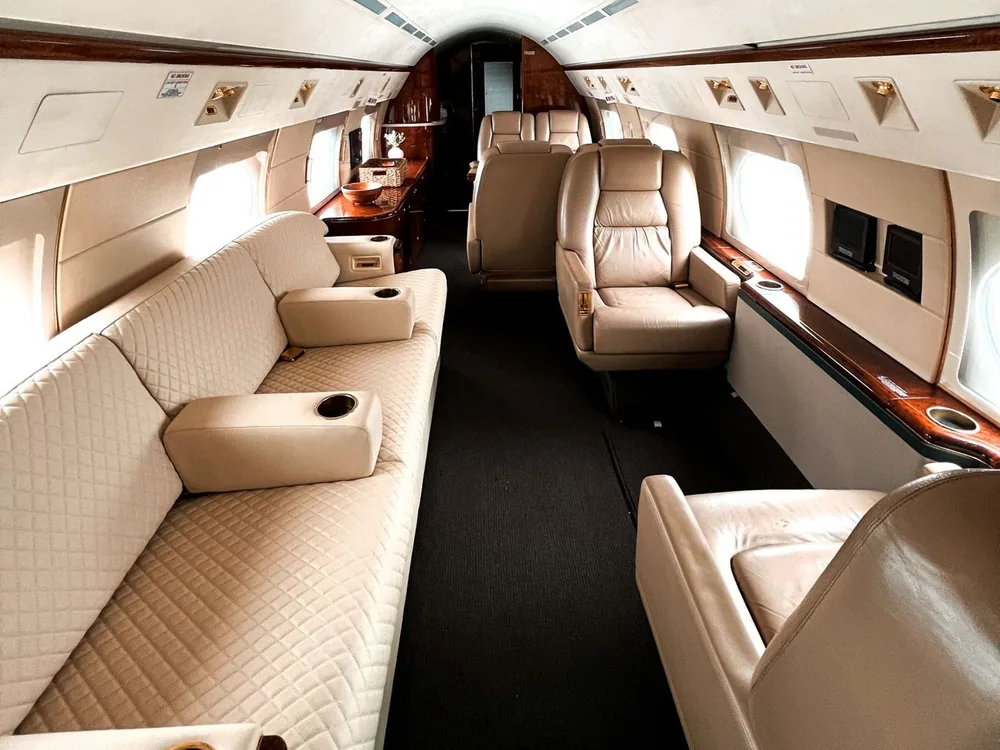
Consider a midsize aircraft when your brief calls for a different balance of cabin space, luggage and journey length. Explain the difference you want to feel: easier movement, a useful table, more separation or a particular seating arrangement. That gives the provider something concrete to evaluate instead of treating “midsize” as a universal specification.
Midsize and super-midsize jets: typically ~$6,500–$9,500 per flight hour.
Reviewed October 2026. ALINARI-selected North American Part 135 planning bands, benchmarked against Paramount Business Jets Charter Cost Guide, Magellan Jets Charter Cost Structure, Clay Lacy Hourly Rate Factors. Published categories and rates vary; Magellan’s premium rates may exceed these bands, and Clay Lacy is historical cost-factor context. Base hourly planning bands exclude positioning legs, 7.5% U.S. Federal Excise Tax (FET) on taxable domestic flights, federal segment fees, FBO/handling charges and international fees. Billable minimums and other trip-specific expenses may also apply. Explore the Planning & Pricing Guide.
THE ONBOARD EXPERIENCE
Balancing stand-up cabin comfort and regional range.
Regional mission planning
For a midsize mission, compare Teterboro (KTEB) or Aspen-Pitkin County (KASE) with Naples (KAPF), Miami-Opa Locka (KOPF) or Nassau (MYNN). The proposal should assess cabin layout, full-party baggage, weather and any fuel stop; Aspen performance and nonstop range require aircraft-specific operator review.
Ask for cabin dimensions, the floor plan and photographs of the aircraft being proposed. Describe whether your priority is walking through the cabin, sitting together around a table or keeping separate spaces for different travelers. A height or width figure cannot show every obstruction, seating position or storage decision. Review the actual arrangement before treating extra space as the answer to your brief.
Be specific about working aboard
If the journey includes work, say what that means. Reading a document, holding a confidential conversation and joining a video meeting create different needs. Ask about the particular aircraft’s connectivity, power and table access, including any limitations or charges. Share essential requirements without putting confidential business material into an initial inquiry. An onboard amenity should be confirmed in the proposal, not inferred from a photograph.
Separate baggage from cabin stowage
Check what a published storage figure includes. External baggage, internal cupboards and smaller stowage areas may serve different purposes. Provide the dimensions of larger items and identify what must remain accessible. Ask how the intended seating arrangement interacts with storage. A maximum combined volume is useful context, but it does not establish that every bag fits or that every compartment can be reached in flight.
Plan the day around the return
A same-day return needs more than an outbound departure. Give the likely end of your meeting or activity, a preferred return window and any uncertainty. Ask how the operator proposes to structure the trip and what would happen if the day runs late. A yacht connection adds another clock: confirm where the boat will finish and allow for its disembarkation and transfer arrangements.
MODEL-SPECIFIC REFERENCE POINTS
Payload, headwinds & nonstop flight profiles.
Published model references help you compare specifications. Your proposal will identify the actual aircraft or vessel and its configuration.
Embraer Praetor 500 — manufacturer reference
Range benchmark
3,340 nm
Standard seating
7 passengers
Cabin height / width
6 ft / 6 ft 10 in
Maximum baggage plus stowage
150 cu ft combined
Range uses four passengers at long-range cruise, with NBAA IFR reserves and a 200 nm alternate. Optional layouts differ; the storage figure combines locations, not one hold. Original Praetor 500 reference, not the 500E.
Use the midsize label to organize alternatives, then compare the actual aircraft. Avoid assuming that every model offers a full-standing cabin, identical seating or the same route capability.
Compare a complete proposal
Look for the exact itinerary, aircraft configuration and operating-provider information, then review inclusions, conditional costs and change terms. If an option is substituted, reassess the practical features that drove your original choice.
CATEGORY QUESTIONS
Questions to confirm on a midsize jet proposal.
Is midsize the right step up from a light jet?+
Start with the unmet requirement. It may be seating layout, baggage fit, cabin movement or the route plan. Ask the provider to show how its proposed aircraft addresses that requirement, rather than upgrading by label alone.
Does a larger baggage figure mean I can bring more cases?+
Not necessarily in the shape and arrangement you have in mind. Ask what the figure measures, which compartments are usable for your items and whether the intended load fits the complete mission. Provide dimensions before the quote is finalized.